
PPC for small business sounds straightforward: pay for clicks, get leads. But the reason so many small business owners end up burned by paid search isn’t bad ads — it’s everything that happens before and after the click. Before you hand a budget to any agency, there are some things worth understanding clearly.
This isn’t a ranked list of agencies. It’s a practical breakdown of what actually determines whether paid search works for a business like yours — in manufacturing, construction, legal, medical, or professional services — and what to scrutinize before you sign anything.
Why PPC Is Harder for Complex Businesses
A home goods ecommerce brand can measure paid search with a single pixel and a purchase event. For a commercial HVAC contractor, a civil engineering firm, or a specialty manufacturer? The math is messier.
Your leads don’t convert the same day they click. Your sales cycle might be six weeks or six months. Your best customers look nothing like your worst ones, and Google’s algorithms can’t tell the difference unless you teach them — through conversion data, audience signals, and consistent negative keyword hygiene.
This is why “we ran Google Ads” often ends in disappointment for service businesses. The platform works. But it needs accurate conversion data, a tight geographic and intent-based keyword strategy, and landing pages that match exactly what the ad promised. When any one of those three is missing, spend leaks fast.
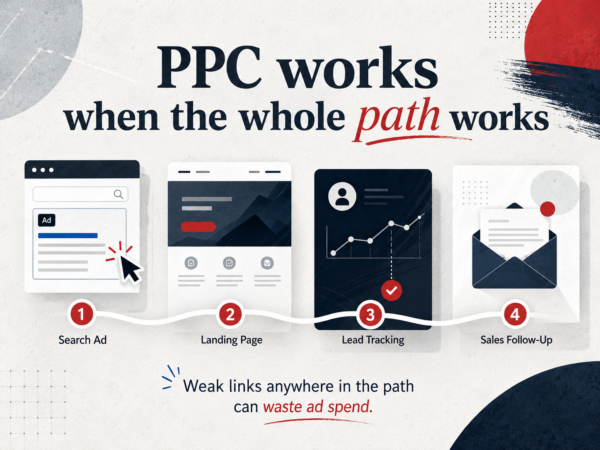
PPC for small business works best when the entire path is connected, from the ad click to the landing page, lead tracking, and follow-up.
The Conversion Tracking Problem Nobody Talks About Upfront
Here’s the thing most agency pitches skip: if your website can’t track what happens after a click, no amount of optimization will matter.
For a small service business, “conversions” often mean:
- Phone calls (with call tracking numbers, not just a click-to-call link)
- Form submissions that actually fire a confirmation event to Google Ads and Analytics
- Chat initiations, if chat is a real lead channel
- In some cases, direction requests or appointment bookings
A lot of small business websites — including ones that look fine on the surface — have broken or incomplete tracking. Someone fills out a contact form and the “thank you” page doesn’t fire a goal. Or calls get attributed to organic when they came from a paid click. When the agency reports “32 conversions this month,” you have no real way to verify that number without clean tracking infrastructure underneath it.
Before you spend a dollar on paid media, get your tracking audited. If an agency’s proposal doesn’t mention conversion tracking setup as a concrete deliverable in the first 30 days, ask why.
Your Landing Page Is Doing More Work Than Your Ad
Ad copy matters. Bidding strategy matters. But your landing page is where most small business PPC campaigns bleed money.
Consider what happens when someone searches “industrial powder coating near Cincinnati” and clicks your ad. If they land on your homepage — with a navigation bar, three paragraphs about your company history, and a phone number buried in the footer — most of them leave. The click cost you $8–$25 depending on your category. And you got nothing.
A purpose-built landing page that mirrors the search intent (services offered, geography served, a single clear call-to-action, and social proof like a client name or a certification) will convert at a meaningfully higher rate than a generic page. This is one of the most documented patterns in paid search performance and also one of the most frequently skipped steps.
Ask any agency you’re evaluating: *Do you build or optimize landing pages as part of your management? Or do you just send traffic to wherever we point you?* The answer tells you a lot about how they think about accountability.
What to Ask Before Hiring a PPC Agency
When you’re evaluating firms, move past the case study slideshow and ask these questions directly:
On measurement:
- How will you set up conversion tracking, and what will count as a conversion?
- Will I be able to see the actual search terms my ads are showing for?
- How do you handle leads that come from paid but close weeks later?
On structure and strategy:
- Will you build separate campaigns for my different service lines or locations, or run everything together?
- What’s your plan for negative keywords in the first 30 days?
- How do you decide when to pause a keyword versus optimize it?
On landing pages:
- Where exactly will my traffic land
- Will you test different landing pages, and who builds them?
On reporting:
- What will the monthly report show me? Clicks and impressions, or cost-per-lead and lead quality?
- Who reviews my account, and how often does a human look at it (versus just automated rules)?
If answers are vague, that’s a signal. A good agency can answer all of these specifically.
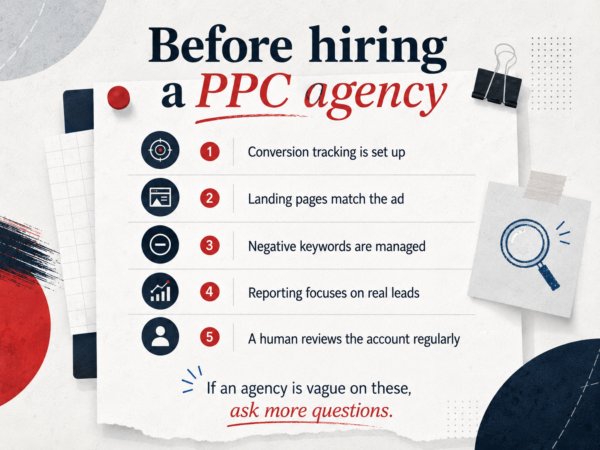
Before hiring a PPC agency, make sure the basics are covered: tracking, landing pages, negative keywords, real lead reporting, and regular human review.
The Budget Reality for Service Businesses
There’s no universal floor for what PPC costs, but there is a practical minimum below which results become hard to generate and harder to learn from.
In competitive service categories — legal, medical, HVAC, specialty manufacturing, construction — cost-per-click on high-intent keywords can run anywhere from $15 to $80+ depending on market. If your total monthly budget is $500, you’re getting a thin slice of data that’s hard to optimize meaningfully. You need enough volume to run tests, identify patterns, and let Google’s algorithms stabilize.
A rough starting point for service businesses: $1,500–$3,000/month in ad spend buys enough volume to get real signal in most mid-sized markets. Management fees are on top of that. An agency that pushes you toward a bigger budget before your tracking is clean and your landing pages are tight is doing it wrong.
Spending less while fixing the foundation first is almost always the better move.
Where Most Small Business PPC Campaigns Go Wrong
After working with businesses across construction, manufacturing, legal, and professional services, patterns emerge:
- Targeting too broad too early. Bidding on generic terms (“lawyer,” “contractor,” “manufacturer”) before establishing which specific services and geographies actually convert.
- No negative keyword discipline.Showing ads for irrelevant searches and paying for clicks that never had a chance to convert.
- Sending all traffic to the homepage. The homepage serves too many audiences and too many purposes to convert paid traffic reliably.
- Measuring the wrong things. Optimizing toward “form fills” that include spam, junk, and out-of-service-area requests — and feeding bad signal to the algorithm.
- Not connecting paid search to CRM. If a lead converts in your CRM three weeks after clicking an ad, that outcome should feed back into your paid campaigns. Most small business setups never make this connection.
None of these are fatal. They’re fixable. But they need to be fixed before you scale spend, not after.
What Good Looks Like After 90 Days
If a PPC program is set up correctly, here’s what you should expect to understand after 90 days:
- Which campaigns, ad groups, and keywords are generating cost-per-lead at or below your target
- Which search terms are converting versus wasting budget
- How your paid traffic is converting on your landing pages compared to your site average
- What the next round of tests will address and why
You should be able to have a conversation about performance at this level of specificity. If your monthly report is mostly a screenshot of impressions and click-through rate with a line that says “performance is trending positively,” you’re not getting what you’re paying for.
If you’re evaluating whether PPC makes sense for your business right now — or trying to figure out why a previous campaign didn’t produce — that’s exactly the kind of problem Formcode works through with clients. Reach out and we can take an honest look at your current setup, your site, and whether paid search is the right next move or if there’s a better lever to pull first.